
Wild Tokyo casino review Australia
 Available in US
Wild Tokyo combines a large multi-provider game catalogue with a mixed fiat-and-crypto cashier. The main trade-offs are payout-linked identity checks, inconsistent withdrawal reports and sharply divided reputation data across specialist and consumer platforms.
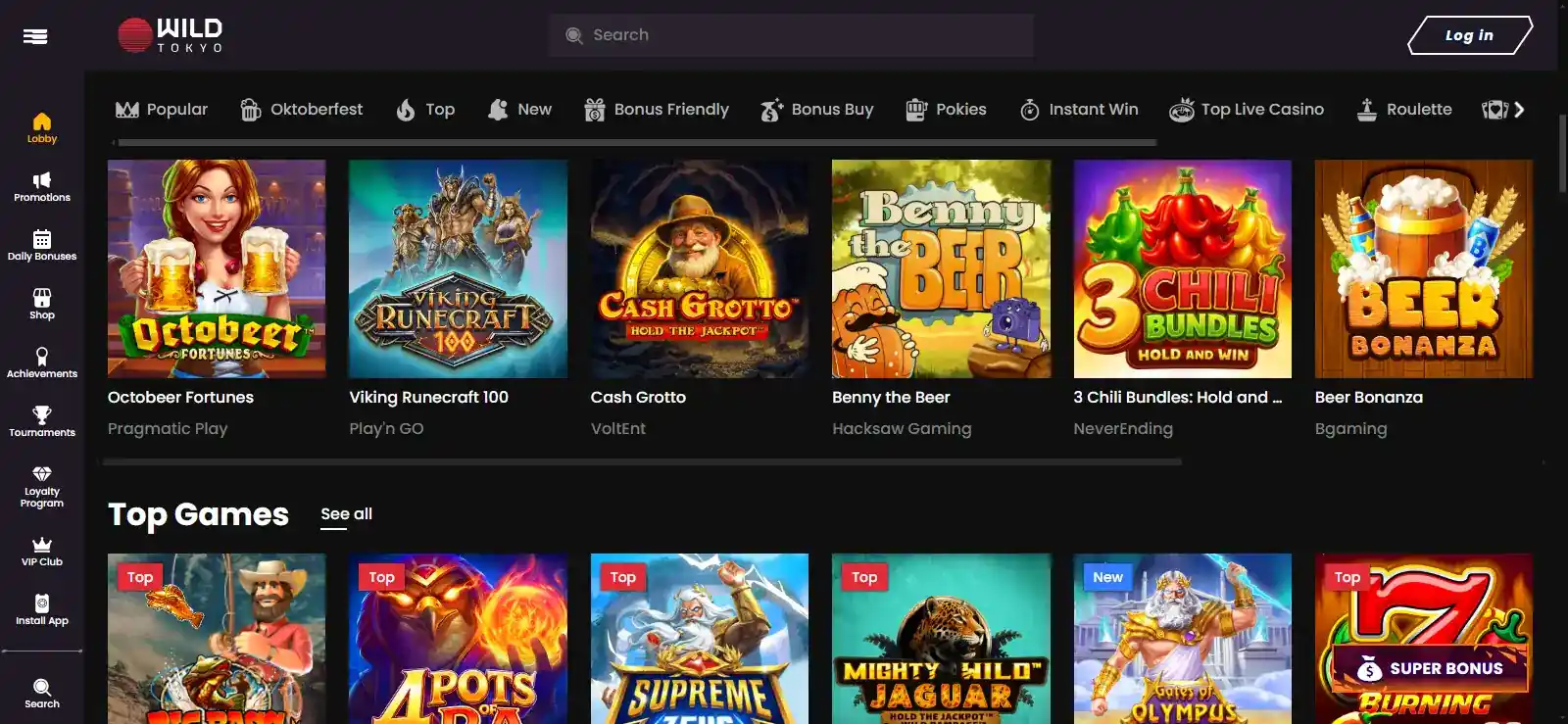
Wild Tokyo dates to 2020 and operates as a hybrid casino, combining card, e-wallet and bank options with cryptocurrencies. Its range spans slots, live dealer games and table games, while withdrawals are linked to identity verification. That combination makes the site broad on choice but more complicated at the point where money leaves the account, because payment route and KYC can both affect the process.
- Launch year2020
- Cashier typeFiat + crypto
- Provider roster152
- Withdrawal controlKYC required
- Support24/7 live chat
Australia: online casino services are prohibited for customers in Australia. See the License section for the Australian legal position and consumer-protection context.
Table of Contents
- Player controls and safer play
- Cards, wallets, bank transfer and crypto share one cashier
- Crypto value check: price movement and transfer costs
- How the product is put together
- Game library reaches well beyond slots
- Account use becomes most consequential at withdrawal
- Bonus terms deserve more attention than the headline
- Ratings and complaints tell a divided story
- Common questions about Wild Tokyo
- Broad choice, uneven service signals
Player controls and safer play
Wild Tokyo includes Take a Break or cool-off, Reality Check and self-exclusion controls. The three controls work at different levels: Reality Check brings elapsed play back into view, a cool-off interrupts access for a period, and self-exclusion creates the strongest stop. Their value is practical rather than cosmetic because the same account also provides access to a large catalogue and multiple payment routes.
- Take a Break or cool-off can interrupt access for a chosen period.
- Reality Check can make elapsed play time more visible during a session.
- Self-exclusion is available as the strongest account-level stop.
Why the controls matter with crypto
Crypto adds a second factor in financial variation beyond gambling outcomes: the asset value can move, and blockchain transfers may be irreversible. A deposit amount expressed in Australian dollars can therefore change in value even before game results are considered.
For help in Australia, Gambling Help Online can be reached at gamblinghelponline.org.au and on 1800 858 858. The service is free, confidential and available around the clock. These controls and support routes should be treated as part of normal account management rather than something reserved for a crisis, because gambling can result in financial loss.
The controls also serve different time horizons. Reality Check is useful inside a session, a cool-off creates a temporary break, and self-exclusion addresses continued access over a longer period. Keeping those functions separate makes it easier to choose a control that matches the problem being managed instead of treating safer-play settings as one interchangeable feature.
Cards, wallets, bank transfer and crypto share one cashier
The cashier is broad. Australian-facing deposit coverage includes Visa, Skrill, Neosurf, MiFinity, CashToCode, Neteller, CASHlib and cryptocurrencies, while the wider payment set also includes Mastercard, PaysafeCard and bank transfer. Crypto choices include BTC, ETH, USDT, SOL, XRP, TRX, LTC, USDC, BCH, DOGE and ADA. The useful distinction is not simply fiat versus crypto: cards and wallets are familiar payment rails, bank transfer is a separate withdrawal route, and crypto adds network choice plus price movement to the transaction itself.
| Rail | Examples in the cashier | What to check before using it |
|---|---|---|
| Cards | Visa, Mastercard | Currency conversion and issuer handling |
| E-wallet and voucher | Skrill, Neteller, Neosurf, MiFinity, CASHlib, CashToCode, PaysafeCard | Whether the same rail is available for withdrawal |
| Bank | Bank transfer | Withdrawal minimum and processing route |
| Crypto | BTC, ETH, USDT, SOL, XRP, TRX, LTC, USDC, BCH, DOGE, ADA | Network choice, wallet fee and price movement |
Network choice and transfer costs can vary by transaction, so the payment flow is the place to check them before moving crypto. Withdrawal figures also need method-by-method treatment: Australian-facing evidence gives different minimums for bank transfer, MiFinity and crypto, while cap and speed figures conflict across profiles. The Payments section separates those details instead of compressing them into one headline number.
The practical difference between the rails is therefore structural. A card or e-wallet deposit is mainly about the supported method and account currency, while a crypto transfer adds wallet handling, network choice and market movement. Bank transfer sits at the other end of the spectrum, with a conventional route but its own withdrawal minimum. Treating every option as if it had the same cost and withdrawal behaviour would hide the most important distinctions.
Crypto value check: price movement and transfer costs
See how a downside price move and two transfer costs can change the value of a crypto deposit scenario. The starting values are examples; replace them with your own figures.
Choose the asset for your scenario. The calculation does not assume a coin-specific fee.
Example starting amount in Australian dollars.
Use 0% for no price change, or move left to model a decline.
Enter the cost shown by your wallet or network for moving funds in.
Enter the cost you want to allow for moving funds out.
BTC scenario
Higher scenario exposure. The combined price move and transfer costs reduce the starting value by more than 10% in this scenario.
How this works
Net value = max(0, deposit × (1 + price movement ÷ 100) − inbound cost − outbound cost). Scenario exposure = deposit − net value. The percentage compares that exposure with the starting deposit.
18+ · Gambling Help Online: gamblinghelponline.org.au · 1800 858 858. Gambling can result in financial loss; crypto values can be volatile and crypto transactions may be irreversible.
How the product is put together
Wild Tokyo is best understood as a large game catalogue attached to a flexible cashier rather than as a specialist crypto-only casino. Conventional payment methods sit beside multiple cryptocurrencies, while the game side covers slots, live dealer tables, roulette, blackjack, baccarat, crash games and other casino categories. The product therefore has two kinds of breadth at once: many studios on the content side and many rails on the money side. That breadth is useful only when the withdrawal path is considered with equal attention, because account verification becomes part of the payout process.
Catalogue breadth
The provider roster reaches 152 studios. Examples include Pragmatic Play, Play’n GO, NetEnt, Nolimit City, Playtech, Evolution Gaming, Quickspin, Yggdrasil Gaming, Hacksaw Gaming, BGaming, Relax Gaming, Ezugi and Spribe.
Hybrid cashier
Cards, e-wallets, bank transfer and cryptocurrencies sit in the same overall product. That creates flexibility, but each rail can carry different withdrawal minima, processing expectations and conversion or network costs.
Payout-linked verification
Identity verification is required before payout processing. Timing estimates and user experiences vary enough that a fixed completion time should not be treated as a promise.

Game library reaches well beyond slots
Slots form only one part of the catalogue. The catalogue also includes roulette, blackjack, baccarat, table games, crash games and live casino. Live dealer games are part of the product, and the provider sample includes long-running studio groups alongside suppliers known for faster or crypto-adjacent game formats.
The provider sample includes Pragmatic Play, Play’n GO, NetEnt, Nolimit City, Quickspin, Yggdrasil Gaming, Hacksaw Gaming, BGaming and Relax Gaming, giving the slot side substantial studio variety.
Evolution Gaming and Ezugi appear in the provider sample, and live dealer games are part of the catalogue.
Roulette, blackjack, baccarat, table games and crash games are all part of the category mix. Spribe is among the named providers.
Provider count and game variety are measures of choice, not measures of expected return. The Games section therefore focuses on category coverage and named studios, keeping catalogue breadth separate from questions of game mathematics.
Account use becomes most consequential at withdrawal
Identity verification is required before payout or withdrawal processing. A 1–5 day estimate is listed, while individual cases can take longer. The practical lesson is that the verification step can become the critical path for a withdrawal, so any timing range should be treated as an estimate rather than a guarantee.
Support access
24/7 live chat is available, and [email protected] is an email support route.
Withdrawal dependency
KYC sits directly in the payout path, which makes document readiness and response time more important than they would be for browsing games or making a deposit.
What to prepare for verification
The key sequence is that identity checks come before payout completion. If the account enters verification, the withdrawal can depend on that process finishing first. Support is available by live chat and email for account-specific instructions.
The Account section separates the firm KYC requirement from variable timing reports and covers the session-control and support routes.
That distinction matters because the withdrawal path combines two separate questions: whether the requested payment route is usable and whether verification has cleared. A fast payment method cannot remove an unfinished identity check, while completed KYC does not turn a conflicting withdrawal estimate into a guarantee. Reading those steps separately produces a more realistic picture of cash-out friction.
Bonus terms deserve more attention than the headline
Bonus headlines vary across region-specific presentations, so the useful part to examine is the mechanics rather than a single headline total. Some deposit bonuses use 50× wagering on the bonus amount, and free-spin winnings can also carry 50× wagering. That means a bonus balance can require substantial turnover before it becomes withdrawable cash, which is more important for understanding the offer than the nominal headline size.
Australian-facing terms have excluded live, table and jackpot games from wagering alongside a longer excluded-slot set. Maximum-bet figures also vary by localisation. The practical reading order is therefore wagering multiplier, eligible games and maximum bet before any headline amount, because those rules determine how the offer behaves in play.
This section is informational only: it does not provide a promotion schedule, code or invitation to claim an offer.
The 50× figure also changes how a headline should be interpreted. A large nominal bonus can still require a much larger volume of qualifying wagers, and excluded game categories narrow where that turnover can be generated. Those mechanics are the useful comparison points because they determine the workload attached to the offer without assuming that a bonus is beneficial.
Ratings and complaints tell a divided story
Wild Tokyo has a strong score on one specialist database and a much weaker consumer-review profile elsewhere. Casino Guru shows a 9.3/10 Safety Index and 21 user reviews. Trustpilot shows a 2.2/5 TrustScore from 263 reviews, with 64% displayed as one-star. The gap is too large to collapse into a single house rating because the platforms are measuring different things and collecting different kinds of user input.
AskGamblers shows 22 player reviews, 14 complaints and a one-day average complaint-response metric. Across complaint histories, KYC and withdrawal delays recur as themes; some cases are resolved and some are rejected. That pattern is useful as a friction signal rather than proof that every player will have the same experience. The practical takeaway is to keep payout verification and withdrawal handling in view alongside the catalogue breadth and payment choice.
The split between a high specialist safety score and a low consumer-review score should not be averaged into one number. A safety index can emphasise terms, policies and complaint handling, while consumer-review sites capture individual experiences that can cluster around service failures. Reading both dimensions preserves the tension in the evidence: the product can look broad and structurally capable while still generating meaningful service complaints.
Read next
- Payment methods and cashier details
- Games and provider coverage
- License and Australian legal position
- Account, KYC and support
Common questions about Wild Tokyo
Which payment methods does Wild Tokyo support?
The cashier supports Visa, Mastercard, Skrill, Neteller, bank transfer and cryptocurrencies including BTC, ETH, USDT, SOL, XRP, TRX, LTC, USDC, BCH, DOGE and ADA. Australian-facing deposit coverage also includes Neosurf, MiFinity, CashToCode and CASHlib.
Is identity verification required before withdrawal?
Yes. Identity verification is required before payout or withdrawal processing. Timing estimates and player experiences vary enough that a fixed verification time should not be treated as a promise.
What games and providers does Wild Tokyo have?
The catalogue covers slots, roulette, blackjack, baccarat, table games, crash games and live casino. The provider roster reaches 152 studios, with examples including Pragmatic Play, Play’n GO, NetEnt, Nolimit City, Playtech, Evolution Gaming, Hacksaw Gaming, BGaming and Spribe.
What do independent reputation signals show?
The reputation picture is mixed. A specialist safety score sits at 9.3/10, while a consumer-review profile sits at 2.2/5 from 263 reviews. Complaint histories also include repeated KYC and withdrawal-delay cases.
Broad choice, uneven service signals
Wild Tokyo’s strongest product argument is breadth: a hybrid cashier, a large provider roster and coverage across slots, live dealer games, table games and crash titles. That breadth is balanced by a payout process that depends on KYC and by complaint histories that repeatedly focus on verification and withdrawal delays. The result is a product that looks strongest at discovery and choice, while the more consequential questions appear later in the account lifecycle when verification and withdrawals matter.
The independent reputation picture is not uniform, so the clearest way to assess the brand is to separate catalogue strength from service friction. Payment route, verification readiness and withdrawal terms matter as much as the number of providers.
Prepared by the Wildtokyoslots.net editorial staff.